|
|
James
McPherson - The Wild Scotchman
|
|
|
There are many very interesting links below all about James and his life. Please have a look around and keep checking back as Edna has many more additions ready to go! (As soon as I can get them online) Click
the spinning E-Mail to send me an e-mail. Click
the spinning E-Mail to send me an e-mail.
|
FORMAT (C) by Edna MacPherson
SABATO.
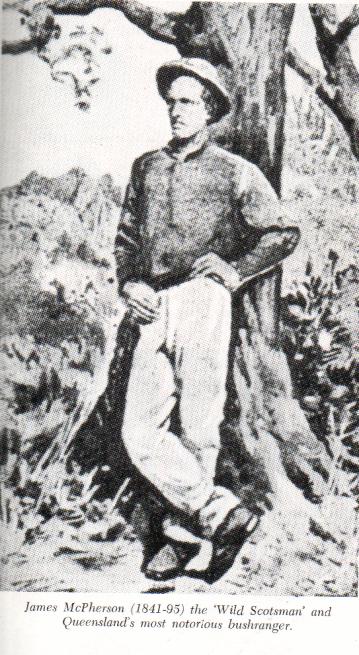
My great-grandfather's brother James McPHERSON, was a bushranger in the 1860's. James McPHERSON was born in Duthil, Inverness, Scotland, on 27th August, 1841, the second son of John McPHERSON, and his wife, Elspeth BRUCE, who emigrated to Australia, with their ten children in 1855. They went to live on Cressbrook Station, in the Brisbane River Valley, working for Mr. McCONNEL. The older boys worked on the station, where James learned to ride horses, and shoot rifles. The older girls did domestic work on the station, and the younger children went to school, on the station, with the Station Manager's children. John eventually bought property at Bald Hills, and moved the family there. James was apprenticed to John PETRIE, in Brisbane, as a builder, where he learned many facets of the building trade. James joined the School of Arts, which had an excellent Library. He became interested in Debating. Charles LILLEY, a Member of Parliament, was trying to bring in an unpopular Militia Bill, and held meetings at various sites in Brisbane. On two occasions when he was speaking in Fortitude Valley, the crowd became unruly, and Mr. LILLEY was saved from "lynching", only by the quick thinking of James McPHERSON. By some strange co-incidence, many years later, Charles LILLEY was Chief Justice at the time of the Bushranger's Trial for Robbery Under Arms. There are many stories about why this happy-go-lucky, educated young man, decided to embark on a life of crime. James was not happy in his apprenticeship, and was encouraged to go shearing with two young men he met. None of them had tried shearing before, with the result that the owner of the sheep, refused them payment for their labours, claiming they had badly mutilated the sheep. James asked for his pay, holding a rifle in his hand, not aimed at anyone, - he just happened to have it with him. The three men then held up the Cardington Hotel, on the Houghton River, near Bowen in North Queensland. During this incident, in March, 1864, the Publican was accidentally shot in the face. James then had a price on his head. James decided to leave the other two men, and headed down into New South Wales, hoping to meet up with Ben Hall and Frank Gardiner, and join their gang. He did a few robberies on the way down, and ran into a lot of police activity in the area , due to the intense pursuit of the local bushrangers, and was shot in the arm during one of the skirmishes. James was captured, and taken to Sydney for trial, but, as Sir Frederick Pottinger, a policeman, was the only witness, and he was accidentally killed on his way to Sydney to give evidence, the charges were dropped. James was extradited to Bowen, to face the charges of the shooting at the Cardington Hotel. James appeared in court a couple of times, being remanded each time, and was being taken to Brisbane on the "Diamentina", when he managed to escape, by jumping over the side, and swimming ashore, even though he was in leg-irons at the time. James then began robbing mails in a widespread area. Pat McCallum was robbed several times, in the Nanango-Gayndah area. If the bushranger needed a horse, saddle, bridle, or whatever, he would help himself to Pat's gear, always returning it, usually with a note, such as - "This is Pat McCallum's saddle - see that he gets it back!" Ned Armitage was robbed twice in the Gin Gin area. James stole only the best race horses from the cattle stations, so was always well-mounted. Once, he entered a stolen race horse in a country race meet, but the owner recognized the horse, and he had to leave in a hurry. On 30th March, 1866, James was riding a tired horse, having ridden from the Gayndah area since the day before, and was captured by Station Managers, and stockmen from Monduran and Gingin Stations, along with a 17-year-old mailman, Ned Armitage. He was taken to Monduran Station, where he was held overnight, tied to a red-cedar tree, whilst a messenger was sent to the Telegraph Station to alert the police, who arrived on 1st April to take him into custody, at Gingin Station, to where he had been moved, from Monduran Station. James appeared in court in Maryborough on 12th April, 1866, remanded, and transferred to Brisbane, where he was tried, and acquitted on the Cardington Hotel charges. He appeared again in Maryborough Assizes on 13th September, 1866, when he was sentenced to two terms of twenty-five years hard labour, to be served concurrently. James was imprisoned on a hulk in the Brisbane River, then four years later, transferred to St. Helena Island, in Moreton Bay, where he and four other men attempted to escape, but were re-captured soon afterwards. While in prison, James wrote some remarkable poetry, in a school exercise book. Some of it was in Latin, and one in particular, contained many references to Greek Mythology. He continued writing poetry right up till the time of his death. Many of his poems were printed in "The Eagle", a newspaper based in Charters Towers. James' father, and several important people in the community, Rev. Benjamin Gilmour Wilson, Mr. McConnel, from Cressbrook Station, who offered to employ him on his station near Hughenden, Mr. Somerset, and Mr. Petrie, to name a few, sent petitions to the Governor, for James' release, when was eventually granted in December, 1874. He went to his father's house, but his father turned him away. James' cousin, Duncan, assisted him on his way to the Hughenden area, where he worked, with Mr. Somerset, on McConnel's station. On one occasion, James saved Somerset's life, in a swimming incident. Four years later, James met and married Elizabeth Ann HOSZFELDT. They had seven children in the following years, one of whom died as a baby. In the early 1890's, James and his family moved to Burketown, on the Gulf of Carpentaria, where he conducted a carrying business. He was well-respected in the community. People knew of his past, but didn't hold it against him. In July, 1895, James attended the funeral of a friend, and on the way back, his horse bolted and fell on him, leaving him with grievous injuries. The doctor could only administer morphine, and he died three days later, on 23rd July, 1895. He was buried in an unmarked grave in Burketown cemetery. Elizabeth and the six children, aged from 15 down to 3, left Burketown, with all their possessions in a wagon, and travelled to the Queensland coast, several hundreds of miles away. They were followed all the way by an aboriginee, who kept saying a word that meant "poor, fatherless children". He protected them all the way. --ooOoo-- |
|